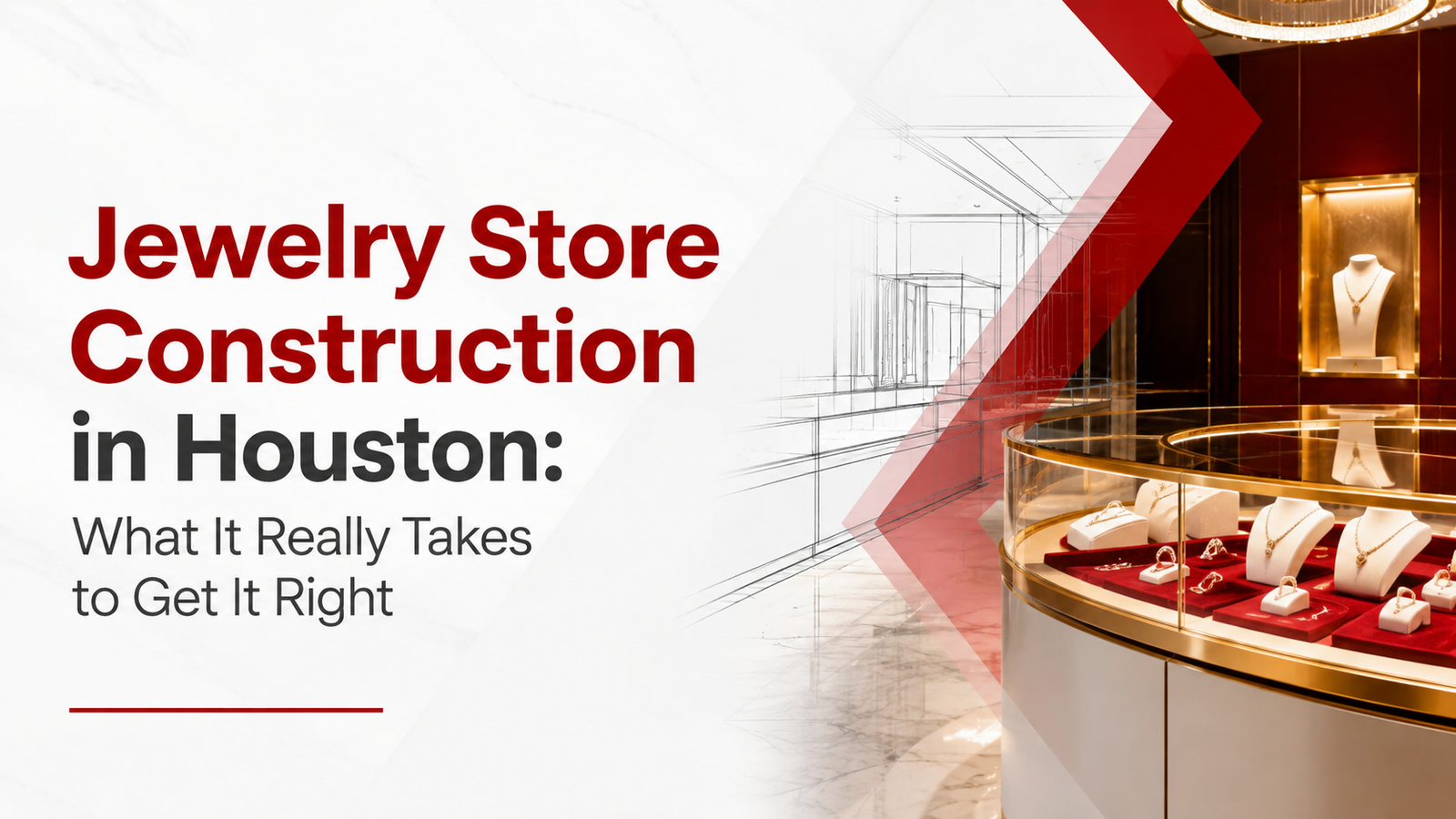
A jewelry store isn’t a boutique with better lighting. It’s a retail environment built around security, precision millwork, and lighting that can make or break how a diamond actually looks under glass — and most general contractors have never built one. Jewelry store construction in Houston involves a different set of decisions than a typical retail buildout, starting with display case engineering and running through vault placement, security conduit, and mall landlord approval. If you’re planning a new location or renovating an existing one, this is what you’ll actually be budgeting and scheduling for.
A jewelry store construction or buildout in Houston typically costs $100–$180 per square foot, driven by custom display case millwork ($800–$2,500 per linear foot), high-CRI specialty lighting, and security infrastructure. Timeline runs 10–16 weeks. SMB Group LLC, an architect-owned design-build firm in Cypress, TX, has built jewelry stores in mall and strip center settings across the Houston suburbs.
Why Jewelry Store Construction Is a Different Category of Retail Buildout
Jewelry retail construction gets grouped with general retail buildouts, but it isn’t the same job. Every element — lighting, casework, flooring, security — has to work together to protect inventory and present it well, and those two goals sometimes pull in opposite directions.
A contractor who’s only built clothing stores or nail salons will treat display cases as furniture and lighting as an afterthought. That’s how you end up with fixtures that don’t fit the cases you actually ordered, or track lighting that washes out stone color instead of enhancing it. Jewelry store construction Houston projects need a team that’s planned the electrical, security, and millwork trades to move together from day one.
How Much Does a Jewelry Store Buildout Cost in Houston?
A jewelry store buildout in the Houston area generally runs $100 to $180 per square foot, depending on finish level, case complexity, and whether you’re building in a vanilla shell or a raw grey shell. A modest 1,200-square-foot strip center location lands toward the lower end; a full mall storefront with custom millwork throughout climbs toward the top.
That range covers construction only. Design, permitting, and security system integration are typically scoped separately but coordinated by the same team if you’re working with a design-build contractor. First-time owners should budget a 10–15% contingency on top of the base estimate — jewelry buildouts tend to surface more electrical and structural surprises than a standard retail shell because of how much infrastructure has to be routed through walls and floors before drywall goes up.
Custom Display Cases: The Dominant Cost Driver
Display case millwork is usually the single largest line item in a jewelry store construction budget, running $800 to $2,500 per linear foot depending on materials, locking mechanisms, and glass type. This is where most of your visible investment goes, and it’s also where the most coordination has to happen with your general contractor.
Cases have to be measured against final wall dimensions, not floor plan drawings — a half-inch discrepancy throws off an entire showcase run. Electrical for interior case lighting needs to be roughed in before drywall closes, and the outlets need to land exactly where the case manufacturer specifies. This is a detail that trips up contractors who haven’t done it before, because it means the case vendor, the electrician, and the framer all need to be reading the same set of coordinated drawings.
Lighting for Jewelry Stores: Why It’s Not an Afterthought
Jewelry lighting isn’t about brightness — it’s about color rendering. Standard retail LED fixtures will flatten the sparkle and warmth that make a diamond or a piece of gold jewelry look valuable. Most jewelry retailers spec lighting at a CRI (Color Rendering Index) of 95 or higher, which is a meaningfully different product and installation than standard commercial lighting packages.
Lighting layout also has to account for glare on glass display tops, shadow patterns from overhead fixtures, and the specific angle of light hitting each case. This gets designed alongside the electrical plan, not bolted on after the ceiling grid is in — which is one reason working with a firm where the architect and the construction team are the same people tends to produce a cleaner result. There’s no gap between what was drawn and what gets wired.
Security Infrastructure: Planning It In, Not Adding It On
Security in a jewelry store isn’t a system you install after construction — it’s conduit, panic buttons, camera mounts, and safe rough-in that need to be planned during framing. Retrofitting security infrastructure after walls are closed means cutting into finished work, which adds cost and delay that a properly sequenced buildout avoids entirely.
A safe or vault, if you’re installing one, has floor loading and access requirements that need to be addressed at the structural stage — this is not something to figure out in week 10 of a 12-week build. Coordinating conduit runs for cameras, alarm panels, and case-level panic hardware alongside the electrical rough-in is standard practice on a well-run jewelry store construction project, and it’s a detail an experienced retail contractor plans for before the first wall goes up.
Mall vs. Strip Center: How the Setting Changes the Build
Building a jewelry store in a mall adds a layer that strip center construction doesn’t: landlord design review. Most malls require storefront design approval, construction hour restrictions, and coordination with mall management for material deliveries and dumpster access — all of which typically add 2 to 4 weeks to the front end of a project timeline.
Strip center jewelry buildouts in places like Katy or Cypress tend to move faster because there’s more flexibility on construction hours and fewer design constraints from a shared landlord. Either setting is workable, but the mall approval process needs to be built into your schedule from the start, not treated as a formality near the end.
How Long Does a Jewelry Store Buildout Take?
Most jewelry store construction projects in Texas take 10 to 16 weeks for construction, plus 3 to 5 weeks for design and permitting on the front end. Mall locations run toward the longer end of that range because of the landlord approval process described above; strip center and standalone locations move faster.
Custom case lead times are worth flagging separately — many millwork vendors need 6 to 10 weeks to fabricate and deliver display cases, which means that order needs to go in early in the process, often before construction even starts, so cases arrive when the space is ready for them rather than sitting in a warehouse or holding up your opening.
Why Jewelry Retailers Choose a Design-Build Contractor
Because a jewelry store buildout has so many trades that need to move in sync — millwork, electrical, security, lighting — owners increasingly choose a design-build model over hiring a separate architect and contractor. When one team designs and builds, display case layout, lighting design, and security conduit get planned as a single integrated system instead of three separate scopes that have to be reconciled mid-construction.
SMB Group LLC is an architect-owned firm based in Cypress, TX that has built jewelry stores in both mall and strip center settings across the Houston suburbs, working with independent retailers and franchise operators alike. Because the firm’s architects stay involved through construction, case coordination and lighting design happen as part of the same process rather than as change orders discovered on-site. Clients also have the option to select flooring — polished tile, LVP, and other finish materials — through AMS Designer Floors & Interiors, SMB Group’s sister showroom at the same Cypress address.
For retailers weighing their options, SMB Group’s retail and jewelry store construction services in Cypress, TX page outlines the sectors and project types the firm has handled.
Frequently Asked Questions
How much does a jewelry store buildout cost in Houston? A jewelry store buildout in the Houston area typically runs $100–$180 per square foot, with custom display case millwork ($800–$2,500 per linear foot) as the largest single cost driver. Final pricing depends on finish level, case complexity, and shell condition.
What type of lighting is needed for a jewelry store? Jewelry stores need high-CRI lighting (95 or above) to render gemstone and metal color accurately — standard retail LED fixtures flatten sparkle and warmth. Lighting layout should be designed alongside the electrical plan to avoid glare and shadowing on display cases.
How are security systems integrated into a jewelry store buildout? Security conduit, camera mounts, panic buttons, and safe rough-in need to be planned during framing, not added after walls are closed. Retrofitting security after construction is finished adds cost and requires cutting into completed work.
How long does a jewelry store construction project take in Texas? Most projects take 10–16 weeks for construction plus 3–5 weeks for design and permitting. Mall locations run longer due to landlord design approval, which typically adds 2–4 weeks to the schedule.
What’s different about building in a mall vs. a strip center? Mall buildouts require landlord design review, construction hour restrictions, and coordinated logistics, adding time to the schedule. Strip center locations, common in Cypress and Katy, generally move faster with fewer outside approvals.
How does SMB Group approach jewelry store construction? SMB Group LLC, an architect-owned design-build firm in Cypress, TX, plans display case layout, lighting, and security infrastructure as one coordinated system rather than separate scopes. Call (281) 272-0786 or visit www.smbgroup.net to talk through your project.
Opening or renovating a jewelry store in the Houston area comes with details a generalist contractor often learns the hard way. SMB Group LLC has built these spaces before, in malls and strip centers alike, and knows what has to happen — and in what order — for the buildout to go smoothly. Call (281) 272-0786 or visit www.smbgroup.net to start the conversation.
SMB Group LLC | 16143 Cypress Rosehill Rd, Cypress, TX 77429 | (281) 272-0786 | info@smbgroup.net | www.smbgroup.net