
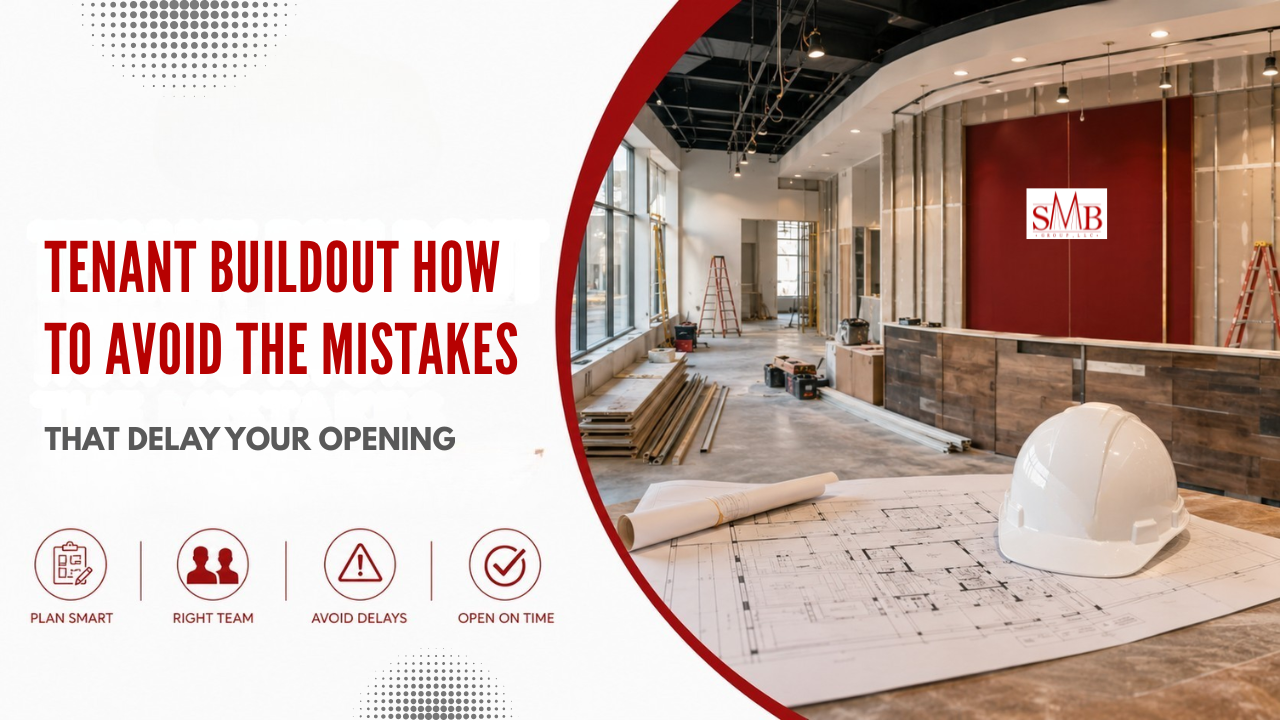
Every commercial lease in Houston eventually lands on the same question: who is actually responsible for building out this space? The landlord? The tenant? Both? The answer is almost always “it depends on your lease” — and that ambiguity is exactly where most opening-day delays begin.
If you’re about to sign a lease for a retail store, restaurant, medical office, or professional suite in Houston, understanding the tenant buildout process before you sign — not after — is the single biggest thing you can do to protect your opening date and your budget.
What Is a Tenant Buildout, Exactly?
A tenant buildout (also called a tenant improvement or TI) is the construction work that transforms a leased commercial space — often a bare “shell” or a space left by a previous tenant — into a finished, functioning business. It covers everything from walls, flooring, and ceilings to HVAC distribution, electrical, plumbing, and finishes.
The critical detail: not all of that work is automatically the tenant’s responsibility. It’s split between landlord’s work and tenant’s work, and that split is defined in your lease’s work letter — the exhibit that spells out exactly where the landlord’s obligation ends and yours begins.
Landlord Work vs. Tenant Work: The Typical Split
| Scope | Usually Landlord’s Responsibility | Usually Tenant’s Responsibility |
|---|---|---|
| Base building shell | ✅ Exterior walls, roof, structure | |
| HVAC (base system) | ✅ Often to the “stub” or rooftop unit | Distribution/ductwork inside your space |
| Utility stubs | ✅ Electrical, water, gas to the space | Connection, distribution, and metering |
| Storefront/exterior | ✅ Often landlord-controlled for uniformity | Signage within landlord criteria |
| Interior walls & finishes | ✅ Framing, drywall, paint, flooring | |
| Fixtures & equipment | ✅ Millwork, kitchen equipment, showcases | |
| Permits for tenant scope | ✅ Usually the tenant’s contractor pulls these |
This table is a general guide, not a substitute for your actual lease language — every landlord’s work letter is different, and “vanilla shell,” “grey shell,” and “warm shell” all mean different starting points. Before you sign, have a contractor read the work letter with you and flag anything ambiguous.
The Mistakes That Actually Delay Openings in Houston
- Signing the lease before getting a contractor’s eyes on the space. Once signed, your negotiating leverage on landlord contributions disappears. A pre-lease walkthrough can catch electrical capacity issues, structural conflicts, or missing HVAC tonnage before they become your problem to fix at your own cost.
- Assuming the TI allowance covers everything. Tenant improvement allowances are often quoted as a flat dollar figure or per-square-foot number, but landlord-required finishes (storefront glass, common-area matching, ADA upgrades triggered by your scope) can consume that allowance faster than expected.
- Underestimating permitting timelines. In Houston, plan review and permitting for commercial tenant improvements go through the Houston Permitting Center, and timelines depend heavily on the completeness and accuracy of your submitted plans. Incomplete drawings mean review cycles, and review cycles mean delay.
- Triggering accessibility upgrades you didn’t plan for. Under the ADA Standards for Accessible Design, certain alterations can require accessibility upgrades to paths of travel, restrooms, or entries beyond your specific scope of work — a common surprise for tenants who assumed only their square footage was in play.
- Splitting design and construction between separate firms. When your architect, your general contractor, and your fixture vendor aren’t coordinated, gaps in scope and finger-pointing on delays are common. A design-build approach keeps one team accountable from drawings to final inspection.
A Realistic Tenant Buildout Timeline in Houston
While every project differs by scope and space condition, a typical sequence looks like:
- Lease negotiation & work letter review — ideally with contractor input before signing
- Design & permit drawings — architectural and MEP (mechanical, electrical, plumbing) plans
- Permit submission and review — through the City of Houston or the relevant local jurisdiction
- Construction — framing through finishes, coordinated in phases
- Final inspections & Certificate of Occupancy — required before you can legally open
Compressing this timeline comes down to two things: submitting complete, accurate drawings the first time, and having a contractor who’s navigated Houston permitting before.
Why This Matters for Your Bottom Line
Every week a tenant buildout runs past schedule is a week of rent, loan payments, and staff costs with zero revenue coming in. Getting the landlord/tenant split right — and having a team that understands both the construction and the permitting side — is what keeps a Houston tenant buildout on schedule.
SMB Group has managed tenant buildouts across healthcare, retail, restaurant, and school spaces throughout the Houston area, coordinating design and construction as one team so nothing falls through the cracks between contractors.
Frequently Asked Questions
Who pays for a tenant buildout in Houston — the landlord or the tenant? It’s typically split according to the lease’s work letter. Landlords usually cover the base shell and utility stubs; tenants typically cover interior finishes, fixtures, and equipment — but every lease is different, which is why reviewing the work letter before signing matters.
What is a TI allowance? A tenant improvement (TI) allowance is a dollar amount, often quoted per square foot, that the landlord contributes toward the buildout. It does not always cover the full cost of the tenant’s scope of work.
How long does a tenant buildout take in Houston? Timelines vary by scope and space condition, but permitting speed is one of the biggest variables — complete, accurate plans submitted the first time move faster through review than plans that require multiple revision cycles.
Should I hire a contractor before signing my lease? Yes, if possible. A contractor’s walkthrough before signing can catch costly issues — inadequate electrical capacity, HVAC limitations, or ADA-triggering scope — while you still have room to negotiate landlord concessions.
Before you sign your next lease, get a second set of eyes on the space. Contact SMB Group for a walkthrough, or learn more about our design-build approach.