A jewelry store buildout in Houston costs more per square foot than ordinary retail because security, display lighting, and custom millwork are built into the space, not added later. SMB Group LLC, an architect-owned design-build firm in Cypress, TX, plans those three items into the design from day one so the walls, wiring, and showcases are all drawn to work together. That’s the difference between a store that opens on schedule and one that gets torn open for a conduit run. If you’re a jeweler about to lease a mall or strip-center space, this guide covers what drives the budget and what to settle before construction starts.
Quick Answer: A jewelry store buildout in Houston typically costs $150 to $300 per square foot for premium retail, with security infrastructure, display lighting, and millwork driving most of the gap over basic retail at $40 to $90. The cheapest way to control that cost is to design security and lighting into the plans before framing begins.
What Drives the Cost of a Jewelry Store Buildout?
Three things drive jewelry store cost: security infrastructure, display lighting, and millwork. Everything else, such as flooring, paint, and restrooms, behaves like any other retail space.
National 2026 benchmarks from Terrapin Construction Group put basic retail hard costs at $40 to $90 per gross square foot, mid-tier retail at $90 to $180, and premium retail at $150 to $300. A jewelry store usually belongs in that last group. For a 1,500-square-foot store, that’s a hard-cost range of roughly $225,000 to $450,000, before inventory, safes, and trade fixtures that are sometimes bought separately.
Those numbers are national, and Houston subcontractor pricing moves around. Treat them as a planning range, then get a design-stage estimate on your actual plan. We cover how that process works in our commercial buildout cost guide.
How Should You Plan Security Into a Jewelry Store Buildout?
Plan security as part of the architecture: a UL-certified alarm, a UL-rated safe, burglary-resistant showcase glass, and controlled entry, all sized and located before the walls go up. Your insurance carrier will have its own list, so ask for it before design starts.
Jewelers Mutual recommends UL-certified alarm systems, and the carrier’s guidance on showcases points to laminated glass paired with sturdy frames, since one without the other can be defeated. Its mall-security guidance also covers showcase upgrades and door-buzzer or mantrap entry. Each of those has a construction consequence.
What the Building Has to Provide
An alarm needs conduit paths and sensor locations. Cameras need cabling and power. A safe is heavy, so the slab, the wall it sits against, and the route it travels from the loading dock all matter. Anchoring points and blocking behind walls have to be in place before drywall closes. If a buzzer entry is part of the plan, the storefront has to be designed around it.
This is why we draw security as part of the architecture instead of leaving it to the alarm vendor after the fact. Because SMB Group is architect-owned, the person who designs the vault wall also oversees how it’s built.
How Do You Light a Jewelry Store So the Product Sells?
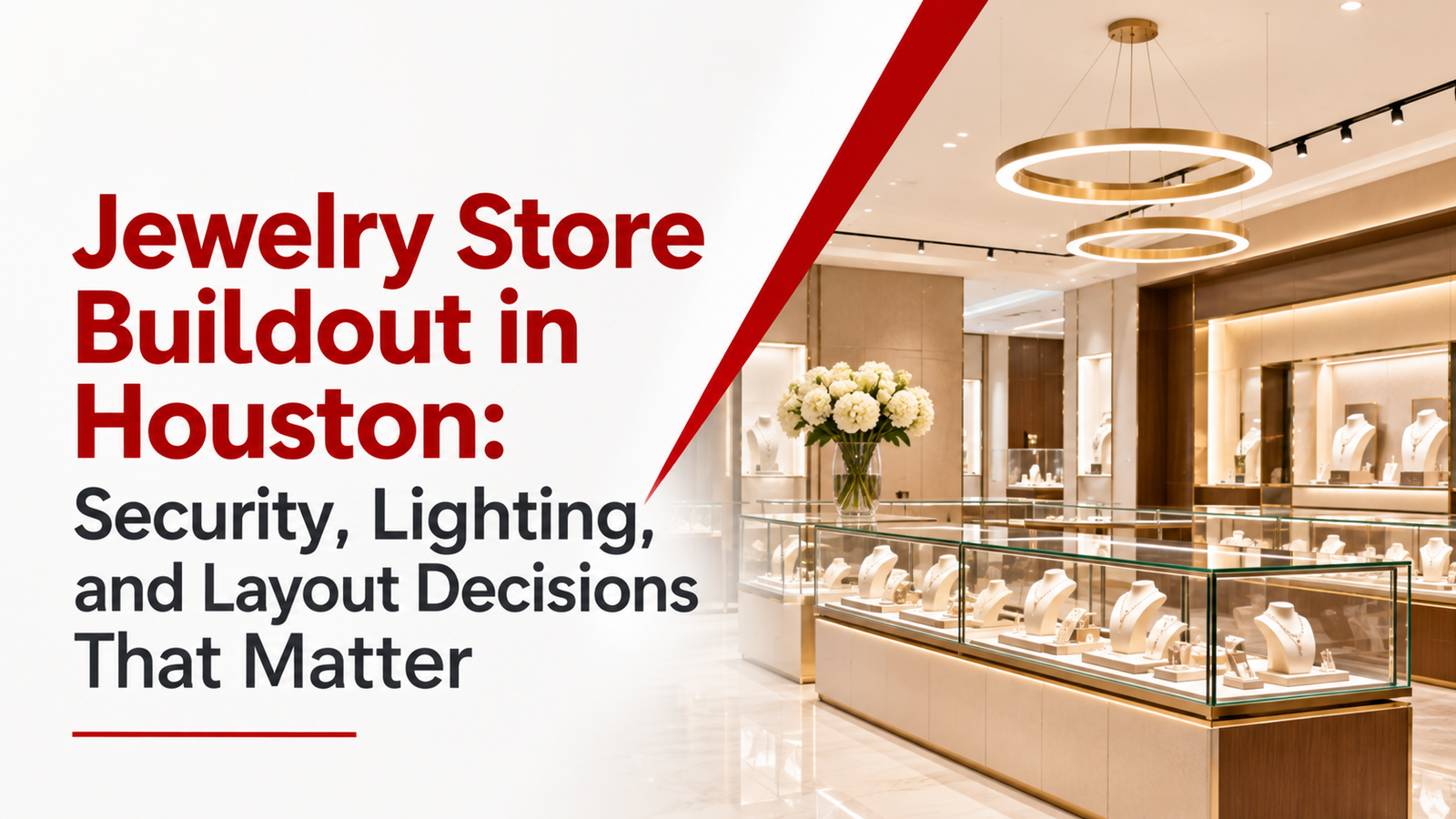
Jewelry lighting works best when it’s layered: soft ambient light for the room, and high-quality accent light aimed at the cases. Light that renders color accurately is what makes gold, diamonds, and gemstones look the way they should.
Many jewelers specify high color-rendering LED fixtures (a CRI of 90 or higher is a common target) and choose color temperature based on what they sell, since warmer light flatters gold and cooler light tends to make diamonds sparkle. A store that sells both often mixes them by zone. The practical point for construction is that accent lighting has to be located relative to the cases, so case layout and ceiling layout get drawn together. Move a showcase six inches after the ceiling is done, and the light no longer lands on it.
What’s the Difference Between a Mall and a Strip Center Jewelry Build?
A mall buildout comes with landlord design rules, approvals, and work-hour limits, while a strip-center buildout gives you more freedom and more responsibility. Neither is better. They’re just different projects.
In a mall, the landlord’s tenant coordinator typically reviews your drawings before you can build, specifies storefront and signage standards, and restricts when noisy or messy work can happen, often to overnight hours. Deliveries, trash, and elevator or dock access are scheduled. In a strip center or standalone building, you’ll generally have more control over the storefront, but you may carry more of the exterior and parking decisions yourself.
Either way, the sequence is the same: read the lease work letter, confirm what the landlord delivers, draw the plan, get landlord and city approval, then build. For mall and retail work in the Houston suburbs, we’d rather help you catch a landlord requirement at the drawing stage than at the inspection. For other retail types, see our retail store buildout guide.
What Permits and Reviews Does a Jewelry Store Need?
A jewelry store needs the same core approvals as any retail buildout: a building permit through the right city or county office, fire code review, and, when the project is $50,000 or more, accessibility registration and review. Cypress addresses outside city limits fall under Harris County; Houston, Katy, and Tomball addresses use their own city offices.
The state’s accessibility rules apply to commercial spaces, and projects at or above $50,000 must be registered with TDLR and reviewed by a Registered Accessibility Specialist. That affects counter heights, aisle widths, and the route from your entrance to your sales floor. Jewelry counters are an easy place to run into trouble if the display design ignores a required accessible service point, so we plan that into the casework from the beginning.
Can One Firm Handle Design, Construction, and Finishes for a Jewelry Store?
Yes. When design, construction, and finishes come from one connected team, the display finishes, flooring, and lighting get chosen against the budget as you go instead of after the drawings are final. That keeps the store looking the way you pictured it.
SMB Group’s sister company, AMS Designer Floors & Interiors, shares our Cypress address, so you can see flooring, cabinetry, and lighting samples in person. A jewelry store lives or dies on its look, and holding a sample under real light beats judging a thumbnail on a screen.
Who Builds Out Jewelry Stores in Houston?
SMB Group LLC is an architect-owned design-build construction firm based in Cypress, TX, serving commercial and residential clients across the Houston metro, including Tomball, Katy, The Woodlands, Sugar Land, and Pearland. They handle everything from initial design through construction and final walkthrough under one contract, with no handoff between separate firms. Their portfolio includes medical offices, retail stores, restaurants, jewelry stores, optical clinics, schools, daycares, religious spaces, and custom homes. Their sister company, AMS Designer Floors & Interiors, gives clients access to flooring, cabinetry, and finish selections through the same team. Reach them at (281) 272-0786 or www.smbgroup.net.
A single jewelry store gets the same attention from us as a full medical building. Many large Houston buildout firms prefer bigger jobs; we like this kind of work.
Frequently Asked Questions
How much does it cost to build out a jewelry store?
Premium retail buildouts, which is where most jewelry stores land, run about $150 to $300 per square foot in hard costs based on national 2026 benchmarks. A 1,500-square-foot store would be roughly $225,000 to $450,000. Security, showcases, and lighting push the number up, while a second-generation space with good bones pulls it down. A design-stage estimate is the only reliable figure.
How long does a jewelry store buildout take in Houston?
Expect roughly four to six months from first design meeting to opening: four to six weeks of design, one to two months of permitting and landlord approval, and two to three months of construction. Mall landlord reviews and security-equipment lead times can add weeks, so order long-lead items early and ask your landlord about its review schedule.
What security does a jewelry store need built into the space?
Insurers commonly expect a UL-certified alarm, a UL-rated safe, and burglary-resistant showcase glass, and many recommend controlled entry. Your own carrier sets the actual requirements, so get its list before design starts. The building must provide conduit, power, blocking, and floor capacity for those systems, which is why they belong in the drawings from the start.
Do I need a contractor who has built jewelry stores before?
It helps a great deal. Jewelry stores combine retail finishes with security and lighting details that ordinary retail contractors rarely handle, and mistakes mean opening walls later. SMB Group LLC builds jewelry stores and other specialty retail across Houston, so these coordination points aren’t new territory. Reach out here and we’ll look at your lease and floor plan.
Can I pick finishes and lighting before construction starts?
Yes, and you should. Finish and lighting choices affect electrical layout, ceiling design, and cost, so settling them during design avoids change orders. At SMB Group, you can review flooring, cabinetry, and lighting at AMS Designer Floors & Interiors, our design center at the same Cypress address, while the drawings are still easy to adjust.
Conclusion
A jewelry store’s success depends on how it feels to walk into and how well it protects what’s inside. Both come from decisions made before the first stud goes up. If you’re pricing a jewelry store buildout in Houston, bring your lease and your insurer’s requirements, and let SMB Group LLC help you build a plan that fits the budget. You can start on our contact page, and we’ll take it from there without pressure.
SMB Group LLC | 16143 Cypress Rosehill Rd, Cypress, TX 77429 | (281) 272-0786 | info@smbgroup.net | www.smbgroup.net